Tag: New York Mets

  • On the Juice

    On the Juice

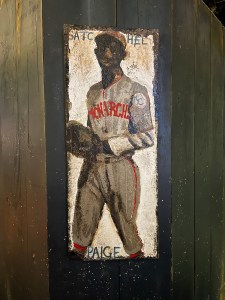
    An artist’ rendition of Satchel Paige
    Negro Leagues Baseball Museum

    I watched with interest as Pete Alonso crushed the competition in the 2021 All-Star Game Home Run Derby earlier this month in Denver, Colorado. As a Met fan, I loved it of course, but it had me thinking about seemingly unrelated things: a book I read as an undergraduate and the legendary pitcher Satchel Paige.

    I couldn’t take my eyes off of Alonso, realizing that I was witnessing a confident athlete, trusting himself completely, and fully in his “zone.” As a performer, I have experienced that feeling too. But I’ve also know the paralyzing feeling of “stage fright.” I’m guessing Pete has too.

    Many of my colleagues are prescribed beta-blockers for controlling the physical manifestations of “nerves” for high profile performances and auditions. I have never taken medication, but I have been given advice for combatting this performance impediment from teachers. I have also developed my own techniques to keep the “negative” effects of adrenaline to a minimum.

    A book that was widely read by music performance students of my generation was The Inner Game of Tennis by W. Timothy Gallwey, first published in 1974. Author Barry Green later came out with a “version” for musicians: The Inner Game of Music was released in 1986 while I was in graduate school. But music students in the early 1980s had little difficulty reading The Inner Game of Tennis and “translating” the advice within to instrumental performance applications all on our own.

    The basic premise of the book is that if one trains over and over to the point where he or she can consistently perform a particular physical feat, one should then trust the body to do what it is well-trained to do and not let self-critical thoughts subvert the performance. Scientists know that the left hemisphere of the brain controls analytical, critical thinking. Gallwey’s book suggests that, allowed to take over the mental part of the game, these left-brain “corrections” can sabotage one’s performance. This can manifest itself by shallow breathing, a racing heart beat, muscle tension, lack of confidence, increased perspiration, sweaty palms, or just plan underperforming.

    Examples of negative left-brain messages might be:

    • “Don’t forget to exaggerate the follow-through on your backhand!”
    • “Don’t rush that upcoming passage with all of those sixteenth notes!”
    • ”Don’t rush your serve!”
    • ”I’m worried I’m going to run out of breath before I get to the end of this passage!”
    • ”My opponent has won so many more big matches than me. How can I possibly beat her?”
    • ”My accompanist said that so-and-so is in the audience tonight.”

    The book goes on to suggest ways of silencing, or at least turning down the volume of those negative voices. This is the crux of the ”inner game.”

    Described in this book and other places is the feeling of “zen” when a performer or athlete is in “the zone”: when he or she is hyper-focused to such an extent that he or she experiences “flow.” When in this state, one is oblivious to external factors: crowd noise, coughing in the audience, one’s own perspiration, even one’s own physical discomfort or pain. He or she has successfully “turned off”—or kept in check—the analytical left-brain’s advice/doubts/caution that can work to hinder his or her performance.


    Or perhaps, I thought as I watched him, Pete Alonso was channeling the great Satchel Paige.

    What I observed in Pete Alonso’s Home Run Derby spectacle was someone in complete “flow,” confident in his physical abilities and seemingly oblivious to any negative thoughts or any other distractions that might make him “press” or otherwise get in the way of the batting skills that he has worked on and at which he has excelled for many years.

    He put complete trust in those skills to serve him as they always have. And they did.

    I was amused, as were many others, to see Pete keeping himself loose by unapologetically nodding in time–like a bobble-head–to the sounds of the playlist he had curated for his Derby at-bats, even dancing at times. Perhaps his physical movements served to perpetuate the “groove” he was obviously in and continuing to win at his “inner game” as well. Or perhaps, I thought as I watched him, Pete Alonso was channeling the great Satchel Paige.


    A promotional poster featuring Paige’s distinctive windup
    Negro Leagues Baseball Museum

    Last month I had an inspiring road trip with my husband to various places in the Midwest. Visiting the Negro Leagues Baseball Museum had been on my Bucket List for some time, so while we were in Kansas City, we made the pilgrimage there. I would have loved to have spent far longer there, but the size and spacing of the crowds inside the museum–during this period of encouraged social distancing–made me slightly nervous, preventing me from dwelling longer in front of the outstanding displays.

    The great pitcher Satchel Paige was certainly well represented in the museum. It was fascinating seeing so many photos of him and the timeline of his career. He was still playing Major League Baseball when he was fifty-nine years old! Thanks to my helpful husband, during the course of our visit, I also learned what “barnstorming” was.

    Barnstorming tours provided the perfect stage for Satchel’s showmanship. His gravity-defying windup was eye-catching for sure, but the entertainment didn’t stop there. He often took an exaggerated leisurely stroll to the mound, clowned around, and engaged in trash talk. And Satchel had the “stuff” to back up his swagger.

    On the barnstorming tours, one of Satchel’s favorite tricks when he was on the mound was to bring in the outfielders and have the infielders behind him take a seat while he proceeded to strike out the side!

    There was a single specific stunt that Satchel was apparently particularly proud of:

    According to Paige, an even more famous stunt came during a Negro League World Series game in 1942, when he intentionally walked two batters so that he could face power hitter Josh Gibson with the bases loaded. After taunting Gibson and warning him about where he intended to place each throw, Paige struck him out in three pitches.

    “10 Things You May Not Know About Satchel Paige” by Evan Andrews

    This guy would have made the most egregious bat-flipper, swag-chain-wearing, homer-horse-riding ballplayer look like a rank amateur.


    I could easily see a bit of Satchel Paige’s theatrical, fun-loving, overly confident barnstorming days in Pete Alonso’s Derby “styling.”

    Gregory Siff designed these bats for New York Met Pete Alonso to defend his title in the Home Run Derby.
    Photo courtesy of Pete Alonso, Lfgm Shop.

    You could also say that Alonso was channeling Satchel in the personalization of his weaponry. He commissioned artist Gregory Siff to create bats for him just for the occasion, each one differing slightly from the other. In interviews and during the broadcast of the Derby, Alonso detailed each bat’s unique story and features.


    Like Pete, Satchel’s larger-than-life persona extended to his “tools.”

    According to Andrews,

    Paige typically relied on his scorching fastball to strike out batters, but he gave the pitch a litany of different names including ‘Bat Dodger,’ ‘Thoughtful Stuff’ and ‘Long Tom.’ He was particularly found [sic] of hurling the ‘Bee-Ball’—a pitch with so much zip that it supposedly buzzed like a bee as it sailed into the catcher’s mitt. As the years passed and his power faded, he fell back on an arsenal of trick pitches such as the ‘Midnight Creeper,’ the ‘Wobbly Ball’ and the ‘Whipsy-Dipsy-Do.’ One of his favorites was the ‘Hesitation Pitch,’ which saw him pause mid-delivery to fool batters into swinging early. The throw usually worked like a charm, but Major League managers complained about it so much that it was eventually made illegal.

    Perhaps you’ve read somewhere Paige’s advice for “staying young?” It has been reprinted elsewhere, but it is famously etched into his headstone. So while we were in town, we went to Forest Hills Memorial Park Cemetery to find Satchel’s final resting place.

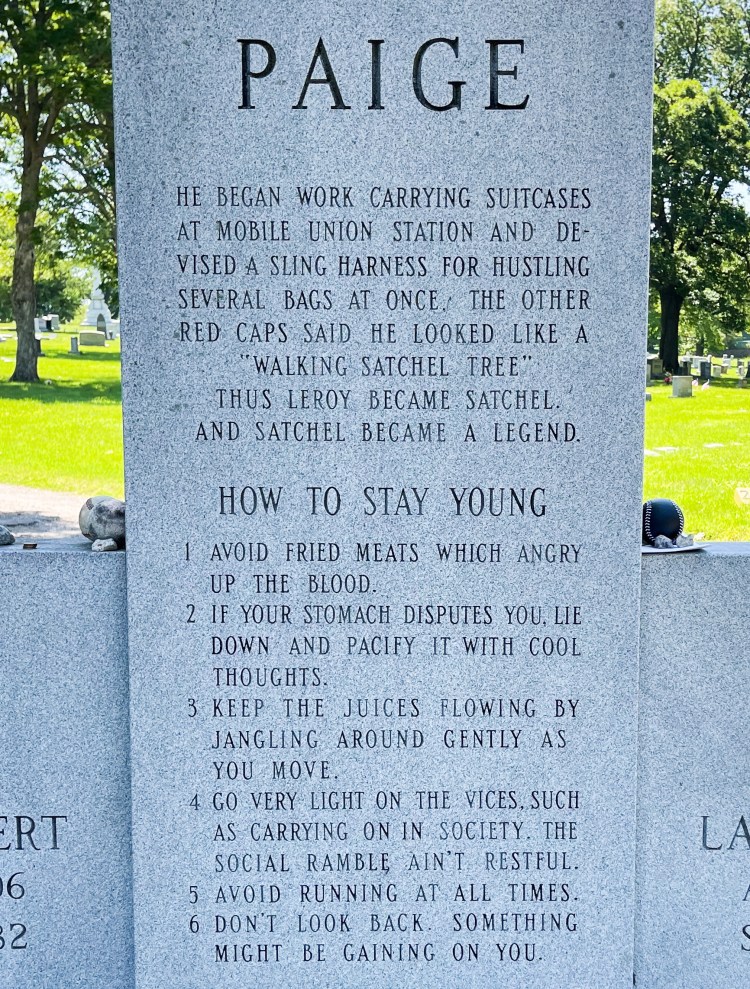
    Having recently seen Satchel’s tips, when I saw Pete Alonso’s dance moves—presumably to keep himself loose during the Derby—I instantly thought of Satchel’s third piece of wisdom.

    Alonso may have referred to his own moves differently, but couldn’t one argue that Pete was “jangling around gently” as he moved? And is it a stretch to say that by doing so he was keeping his “juices flowing?”

    But just maybe Paige “jangled gently” to avoid jangled nerves.

    Were Satchel’s “juices” a euphemism for blood—meaning to keep one’s circulation flowing?

    Perhaps when Satchel got on base and took a lead off the bag, he “jangled gently” in order to avoid being flat-footed. Jangling could have kept him light on his feet, enabling him to spring, cat-like, back to the base in order to avoid getting tagged out or allowing him to get a good jump when attempting to steal a base. In that case, I saw plenty of jangling from former Met José Reyes.

    But just maybe Paige “jangled gently” to avoid jangled nerves.

    Maybe keeping his “juices flowing” was a description of Satchel’s strategy for playing his “inner game,” listening to his own inner rhythms, keeping his athletic juices AND positive thoughts “flowing.”

    Could this be Satchel putting Rule No.2 to use? Pacifying his mind “with cool thoughts?”

    St. Louis Browns pitcher Leroy “Satchel” Paige relaxing in his bullpen rocking chair
    reading a newspaper during a game, ca. 1952. Photo Credit: Missouri History Museum

  • My “Al Jackson Story”

    Mets fans who are readers of mainstream and social media no doubt found many detailed tributes to Al Jackson today. Jackson, an original Met, passed away yesterday at the age of eighty-three. My husband, a rabid reader in general and a consistent consumer of Mets-related media, began reading the tributes to Jackson as they began to pour in online late last night. At that time, he remarked to me, “It appears to me that every beat writer and Mets blogger has his or her own personal Al Jackson story.”

    Providing consistently insightful, elegantly written, and often moving posts chronicling all things Mets, Greg Prince of Faith and Fear in Flushing did not disappoint in his tribute. In it, he alludes to the late pitcher’s longevity and devotion to the Mets. Prince’s detailed description of Jackson’s long tenure with the team, along with the title of the post–“Family Man”–conjured, for this reader, an image of an athlete who had experienced challenges resembling those of a parent.

    Jackson had been there from the team’s conception, earliest contractions and painful birth, had experienced the mind-numbing weariness and frequent exasperation that accompanied its infancy, had endured the “terrible twos” (and “threes”), its hormone-addled adolescence, and had stayed long enough to witness the team reach some manner of maturity and responsibility.

    Jackson was one of thirteen children. He is survived by two sons and two grandsons. Similarly, his baseball “family tree” has many branches with countless connections to current and former players, coaches, staff, and media personnel.

    In the very same year that the Mets were born in New York, I was born in Kansas. My connection with the Mets family would come much later in my adult life. Even so, I too have an Al Jackson story:

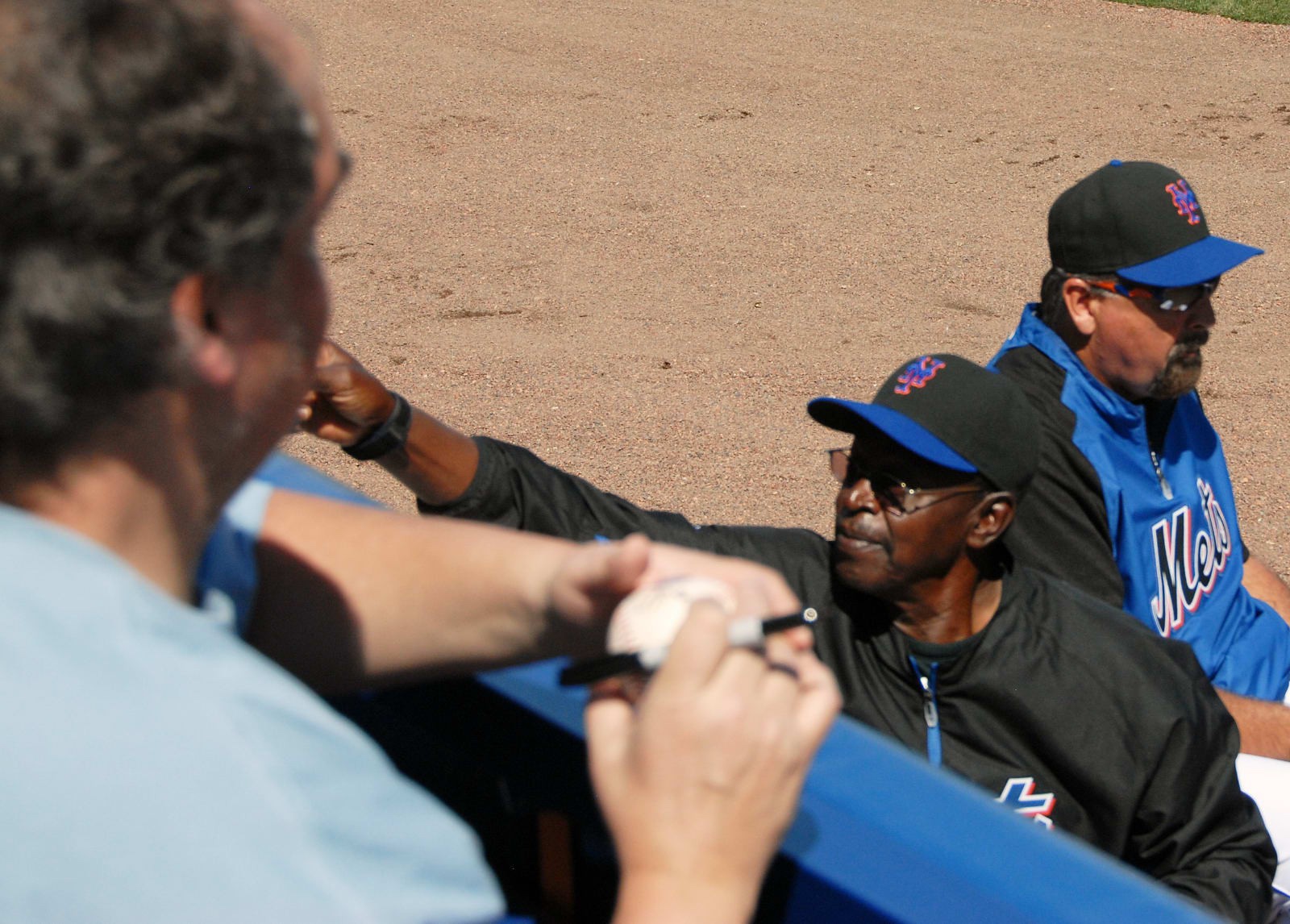
    My family and I travelled to Port Saint Lucie for Mets Spring Training games in 2011. Having seen Al Jackson with the other pitching coaches seated near the mounds just outside the third base line, my husband pointed out Jackson to my daughter and me. He told us that he had seen Jackson play and that Jackson had been an original Met.

    Armed with this info, before the start of the game, my daughter walked down to the row of seats just above where Jackson was seated, got his attention, and politely asked him for an autograph.

    He obliged, signing the baseball she proffered. As he did so, she mentioned that her Dad had seen him pitch for the Mets. According to her, Jackson smiled broadly, wryly asking, “Are you sure that wasn’t your GRANDDADDY who saw me pitch?!”

    These photos captured that special moment. May Al Jackson’s family and friends be blessed and comforted with the memory of their own Al Jackson stories.

  • A Mets Memory

    A Mets Memory

    By Garry Spector, Guest Blogger

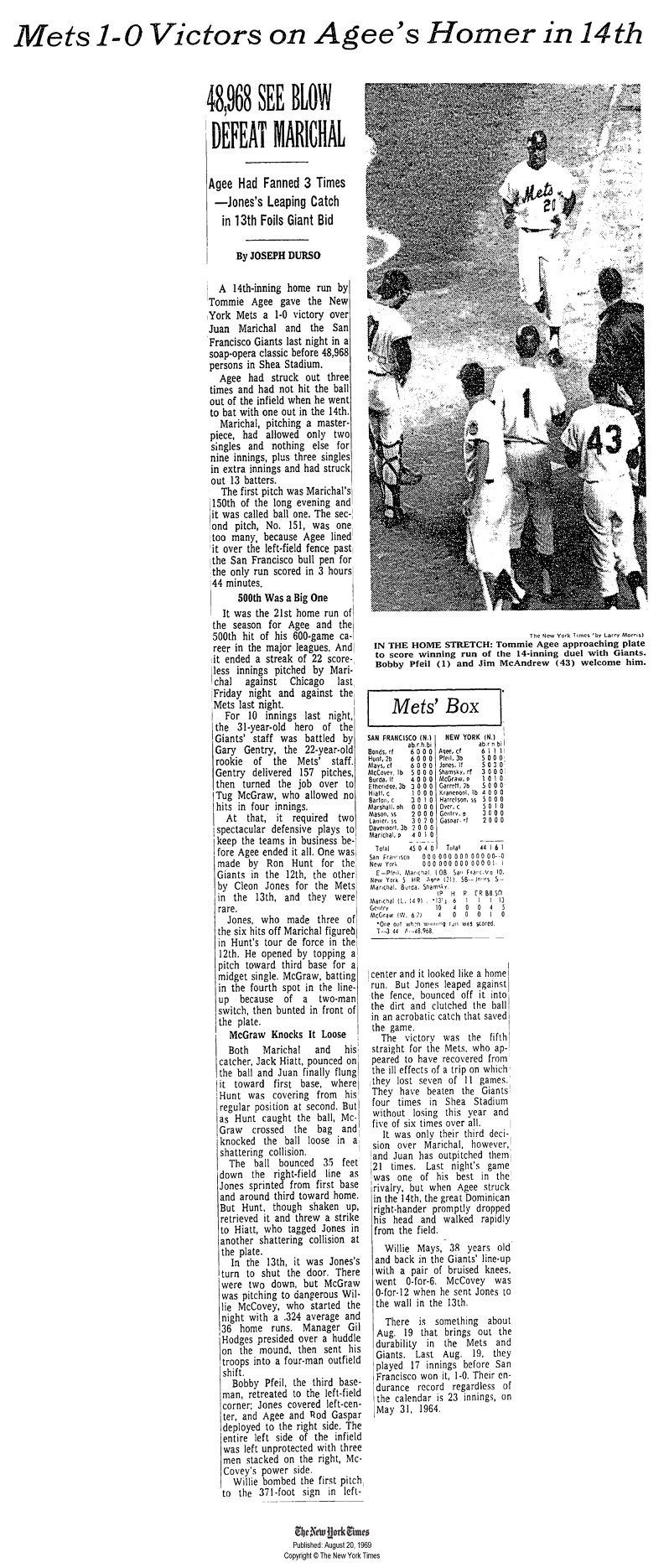
    Fifty years ago today, Tommie Agee hits a walkoff homer (we didn’t know the term at the time) off Juan Marichal in the 14th inning to beat the Giants 1-0. Marichal was the starting pitcher and threw a complete game: 151 pitches. Imagine THAT today!

  • Fifty Years Ago Tomorrow, I Cried Myself to Sleep

    by guest blogger Garry B. Spector

    We just celebrated the 1969 World Champion New York Mets with a marvelous ceremony at Citi Field. Unfortunately, Tom Seaver could not be there. It was announced in March that Seaver, suffering from dementia caused by Lyme Disease, was retiring from public life. But he was there in spirit–and with his daughters and grandchildren in attendance, when the Mets announced the new address for Citi Field at 41 Seaver Way in a ceremony last week.

    There are countless memories of that 1969 season that remain with me. Maybe the most exciting one of all took place 50 years ago tomorrow–July 9, 1969, when Seaver took a perfect game into the 9th inning against the first place Cubs, a team with 3 Hall of Famers in their starting 8 (Santo, Banks, Williams). The Mets had won the day before with 3 runs in the 9th inning off another Hall of Famer, Ferguson Jenkins. A crowd of over 59,000–far beyond the seating capacity of Shea Stadium, was there to witness Seaver’s gem.

    The Voice of the Mets, Howie Rose, was in attendance that night and wrote about it brilliantly in his book, Put it in the Book. He had been attending Mets games since 1962, and had never seen anything like it.

    Scorecard ©2019 Ultimate Mets Database (www.ultimatemetsdatabase.com)

    Seaver retired the first 25 batters, needing only 2 more outs to achieve perfection. To that date, 50 years ago, there had only been seven perfect games pitched in the modern (post-1900) era. In fact, there had been no perfect games pitched in the regular season between 1922 (Charlie Robertson of the White Sox) and 1964 (Jim Bunning of the Phillies against the Mets at Shea); Don Larsen’s perfect game in 1956 World Series was the only one that took place in 42 years. This eleven year old Mets fan knew enough baseball history to realize what was happening, and how rare the feat actually was.

    After Randy Hundley tried to bunt his way on base leading off the ninth (Seaver threw him out), Jimmy Qualls, a rookie, stepped to the plate. He was playing only because Don Young, the regular CF, had been castigated by Leo Durocher and his Cubs teammates for losing the previous day’s games. Qualls ruined the perfect game by slicing a line drive single to left center field. Seaver got the next two outs and completed a one hit shutout.

    Listen here for Lindsey Nelson’s radio call for WJRZ-AM 970.

    Luckily, the game was televised in the Albany, NY, area where I grew up.

    My mother assured me that I would see a Mets perfect game someday (I’m still waiting). And this eleven-year-old cried himself to sleep.

    No July 9 has passed since without my remembering that game. What a thrill it was then–and it remains so today.

  • David Wright: A Tribute

    David Wright
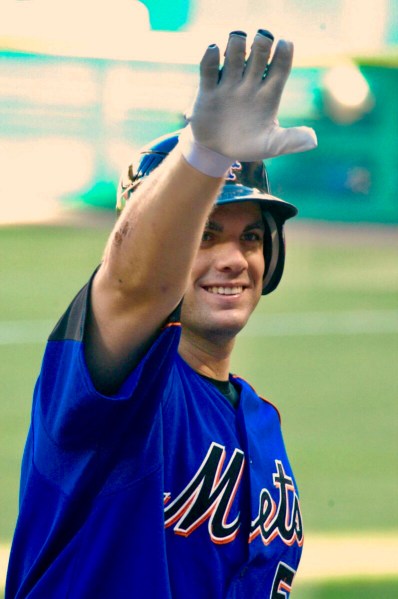
    David Wright waves to fans during batting practice. © Susan Spector.

    In 2005, my family and I purchased a Mets partial season ticket plan. A lot of wonderful things were to follow.

    Some of them even involved the games themselves.

    The following year, anticipating the ticket demand resulting from the team’s upcoming move from Shea Stadium to Citi Field, we ponied up and became full season ticket holders. We have continued to renew our plan every year since then.

    At first, my husband and I didn’t always see as much of the games as we might have liked, our young daughter’s attention span often limiting us to four or five innings at most. Her interest–and longevity–increased with age. She learned more about the game and its history. She read and learned about our players and their positions, and she developed a particular affinity for certain players. Her involvement with and appreciation for baseball reached an even higher level when her father taught her how to score and she began keeping a score book.

    With each passing year and season, our shared experiences have brought our family closer together. We have made new friendships—with those regulars seated near us, with members of the media (particularly the Mets Radio personnel), with members of the Citi Field Season Ticket Account Services staff, as well as with members of the Security detail and Concessions staff. Some members of our “summer family” have become year-round friends. We have made road trips to see the Mets, our travels taking us to see them play in every single National League ballpark and even a few American League parks. Those road trips have been coupled with side trips to historical and cultural attractions in those cities and have provided opportunities to see family and friends in the area.

    From a personal standpoint, my interest in the Mets rekindled my passion for writing, resulting in the creation of this very blog. Going to an average of eighty games a year, I found myself looking for images that were unique to each game or home stand and wanting very much to document what I saw.  I was inspired to take photography classes, and I acquired more sophisticated equipment.  The results were images that were a step above those I had previously shot:  in composition, control, and resolution.

    With years of photos on my hard drive, it took me a while to assemble some of my favorite photos of David Wright for this slide show. These photos (and videos) were shot during games and batting practice at Shea Stadium, Citi Field, and in Port St. Lucie; at RFK Stadium and Nationals Park; at Dolphin Stadium and Marlins Park; and at Citizens Bank Park, Turner Field, Wrigley Field, Great American Ballpark, Miller Park, PNC Park, A T & T Park, PetCo Park, Dodger Stadium, and Minute Maid Park, as well as at special Full Season Ticket Holder events.

    Because my family and I have been Mets season ticket holders since just about the time David Wright came up to the big leagues, in some ways it feels like we watched him “grow up” in Queens. Being at Citi Field for his final game and farewell to Mets fans this past September—after watching him play his entire Major League career with our team–it was impossible not to shed a tear.

    You will be missed, dear Captain. 😢

  • Personal Best

    unnamed
        Hey, I know this guy!!

    I’m the proud friend of several prolific baseball writers.  In the past, I’ve referenced here the fine work of Greg Prince and Jason Fry   My seat for Mets games is in Section 318–right in front of the WOR-710  Mets broadcast booth.  Over the years, the fact that I always have the Mets Booth radio guys in my ear during games–and often pantomime my reactions to their always insightful and entertaining commentary–and that I regularly trade tweets with “the immortal” Chris Majkowski during games, have resulted in a friendship with the radio personnel, including sportscaster and author Howie Rose.

    Mark Newman does not write about the Mets exclusively, but he has spent a fair amount of time at Citi Field.  He has been a longtime Hall of Fame voting member of the Baseball Writers’ Association of America.  He is the recipient of the National Magazine Award for General Excellence.  He has worked twenty-five World Series for Major League Baseball.  It was through his position with MLB’s Advanced Media–for which he is currently Enterprise Editor–that I got to know him.  Mark was a guru/”cheerleader”/problem-solver for all of us novice fans starting to blog about our teams for the first time.  He was most helpful in providing guidance, encouragement, and helpfulf feedback to this Mets blogger. Since starting Perfect Pitch, I’ve had a chance to share some memorable games with Mark at Citi Field, and he and his wife Lisa have attended a few Opening Night Galas at the Metropolitan Opera as well.

    Suffice to say, Mark has been around baseball and is accustomed to posing questions to ballplayers.

    But for almost as long as I’ve known him, when he’s not involved in a specific work assignment for MLB, Mark’s been meeting one-on-one with players in pursuit of their answers to a single query:  given the opportunity to cite a single at-bat as the most memorable of your career, which one would you choose?

    MarkandMike-2
            Mark Newman (right) poses his oft-repeated question to Mike Schmidt.

    He’s talked to current players, players who retired long ago, and Hall of Famers.  He’s met them at batting practice, at foundation fundraisers, on golf courses, over lunch, dinner, or a cup of coffee–any number of scenarios that afforded the time and place for a bit of introspective reflection, “off the record” and away from the player’s team, his family, and the public.

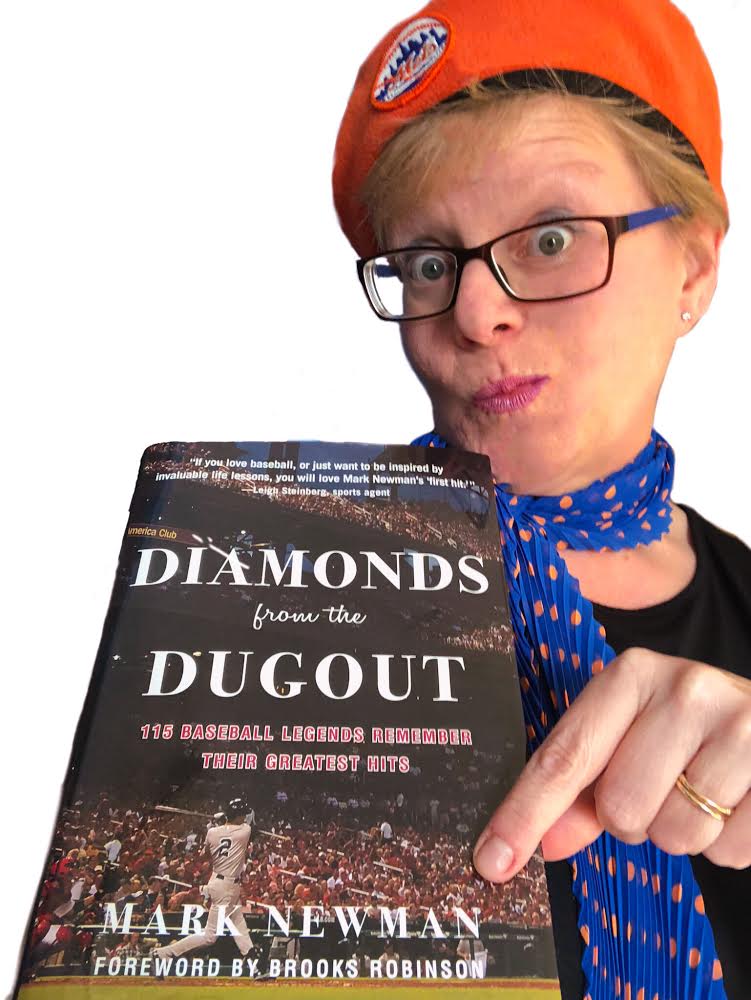
    The resulting answers, Mark found, were intriguing, fascinating, and quite often, they came as a surprise.  A publisher had the same reaction.  A book, entitled Diamonds from the Dugout, envisioned and written by Mark–with encouragement from Brooks Robinson–is the happy result.  It came out just this week.

    Fans, the media, statisticians, bloggers, and baseball historians have time-honored criteria for quantifying or qualifying an individual athlete’s performance relative to his peers.  They are also afforded their respective platforms for self-cultivated “highlight reels” of their own selection.  Some of the crowning points shared with Mark by these ballplayers might be seen as relatively unremarkable, from a strictly baseball point of view; what is noteworthy is the reason why this is the hit selected by the player himself and given its own chapter in Mark’s book.

    The subject of each chapter is certainly a measure of athletic accomplishment, but more often a player’s selection had more to do with the context in which the hit was made. Mark skillfully weaves together the specifics of the play with anecdotal information from the player.  Reading these vignettes, one can easily visualize the whimsical grin playing across the face of a player or the slight misting up of a player’s eyes involved in the hit’s memory and his retelling a story that, for that player at least, has obviously become the stuff of myth or legend.  The inclusion of each player’s “back story”, the opportunity for him to “set the stage” and to add personal embellishments to his saga:  this is what makes the book fascinating reading.

    The book is a veritable Who’s Who of baseball royalty, but as a Mets fan, you’ll particularly enjoy reading chapters devoted to David Wright, Mike Piazza, Ron Swoboda, Mookie Wilson, Darryl Strawberry, Rusty Staub, Ed Kranepool, and Ralph Kiner.  I particularly liked Staub’s tale involving a multiple-hit game as a young player for the Astros in May of 1967.  The legendary Ted Williams was in the house–not as a player, but as an award presenter.  Williams had scouted Staub in high school for the Red Sox, and on that day, he witnessed Staub go 3 for 3 with a run scored in the 6-2 victory.  Staub recalls that his efforts that day garnered words of high praise from Williams that he remembers vividly to this day, “You’re gonna be OK, kid.”

    Conversely, Mets fans will enjoy Chipper “Larry” Jones’ favorite hit for the mere fact that it did not take place against Mets pitching. Considering the plethora of killer at-bats inflicted by him upon my team, I was relieved to find that his chapter does not constitute a nostalgic recounting of a nadir of Mets family lore.

    It’s a hard time for Mets fans:  we had high expectations and low return this season.  Meanwhile the team across town has powered its way to the ALDS.  Trust me, there’s no better time to get lost in a book, if you’re a Mets fan.  And I highly recommend you pick up a copy of Mark’s book today!

    UPDATE:  The hardcover edition of the book is once again in stock at Amazon.  For shoppers in the New York City area, Barnes & Noble stores expect to have the hardcover available in its tai-state area stores and for free delivery to select area zip codes by Wednesday, October 11th.

    NOTE:  As of this writing, Amazon is temporarily out of stock of the hardcover edition of the book.  However, it is available on Kindle for instant download.  The hardcover edition is currently available on Barnes & Noble’s website , and it is also available as a download for Nook.  

    For more information about Mark Newman and his book, please check out his website as well.

    SaveSaveSaveSaveSaveSave
    (more…)

  • #PaintItYellow

    Nationals Leaving RFK
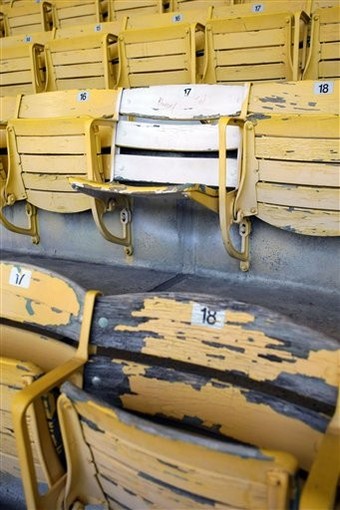
    A white seat in the leftfield upper deck section of RFK Stadium, marking the spot where Washington Senator Frank Howard hit a home run, is surrounded by other faded and cracked seats before the start of the baseball game between the Atlanta Braves and the Washington Nationals, Sunday Sept. 16, 2007, at RFK Stadium in Washington. (AP Photo/Pablo Martinez Monsivais)

    Unparalleled by any other sport, baseball is a game of numbers.  Of statistics.  Of quantifiable accomplishments.

    In music and other art forms, measures of success or achievement are far more subjective.    There will never be a “greatest” or “best” soprano, symphony, or even composer.

    With the exception of a few asterisks or footnotes, when an outstanding baseball achievement is made,  the record book is immediately updated, and the recipient and his feat are honored.  At least until the next player comes along and breaks that record.

    The quantifiable aspect of the sport affords an auspicious status to players that is not available to artists.  In sports, one can be considered the reigning champion of one or numerous particular feats:  the very “best”.

    One particular feat happened at Citi Field last Thursday night:  Outfielder Yoenis Céspedes became the first player ever to hit a ball into the third deck of the ballpark.  Anyone watching the 2013 Home Run Derby portion of the All-Star Game festivities will remember those bombs hit by Céspedes, including one that drilled the glass exterior of the Acela Club in Left Field.  While Thursday’s home run was calculated to have been hit 466 feet–which constituted a tie with Giancarlo Stanton for the furthest hit fair ball in Citi Field–it was an  unprecedented feat because of the sheer height of the home run.  The surprise on the fans’ faces in the third deck–where the ball landed–speaks volumes:  no one sitting in those seats ever expects to go home with a souvenir.  Not even from batting practice.

    090708.01
    The marker for Tommie Agee’s Upper Deck home run with the author’s spouse and daughter.

    Earlier in the history of the franchise, an equally impressive bomb was hit–and immortalized.  In the third game of the 1969 season, outfielder Tommie Agee socked a ball that landed halfway up in Section 48 in the left Upper Deck at Shea Stadium.  Eventually, the spot where the ball was hit was painted.  Unfortunately, during the demolition of Shea Stadium, the marker was removed and was sold to a private collector.

    The stadiums that have chosen to place physical markers where players have hit home runs are numerous:

    Fenway Park boasts its singular “red seat” where, on June 9, 1946, Ted Williams hit a homer–Section 42, Row 37, Seat 21–for a recorded distance of 502 feet.

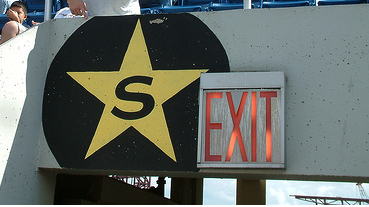
    HR Stargell1Veterans Stadium in Philadelphia at one time had markers for home runs hit into the left-field upper deck by Greg Luzinski and Mike Schmidt.  A home run by a non-Phillie, Willie Stargell of the Pittsburgh Pirates, even warranted a marker there:  a yellow star with a black “S” in the middle.


    RFK Stadium in Washington, D.C., boasted numerous seats painted white–against the prevailing sea of yellow seats–denoting places where Frank Howard, a.k.a., “The Washington Monument” and “The Capital Punisher”, hit home runs during his tenure with the Washington Senators.

    Baltimore’s Camden Yards has countless markers embedded into the pavement for those homers hit onto Eutaw Street.  But in this digital age, they even have an online “Eutaw Street Home Run Tracker” where one can watch the arc of all 85 homers (at last count), that has landed there.  Two orange seats reside there as well:   the first was installed in honor of Cal Ripken Jr.,’s record-breaking home run on July 15th, 1993, in which he passed Ernie Banks for the most home runs ever hit by a shortstop.  The second orange seat marks the location of Eddie Murray’s 500th career home run of September 6th, 1996.

    4191431661_90d174c00a_z-2Camden Yards’ predecessor–Memorial Stadium–commemorated Frank Robinson’s monumental homer of May 18, 1966, which sailed 451 feet over rows of bleachers and out of the ballpark.  This feat was commemorated by an orange banner over the left-field bleachers with the single word “here” printed on it.

    raderwynn


    Houston’s Jimmy Wynn and Doug Rader each hit homers into the left field upper deck at the Astrodome in 1970. The home runs were hit a week apart and to the same row in the upper “Gold Level” with just a few seats separating them. The Astros had an artist paint the seats to mark them. They remained in place until 1985 when the seats were refurbished and repainted to match the blue, red, orange and yellow of the Astros rainbow jerseys (which ironically they stopped using just two seasons later). The seat locations were remarked during the renovation.

    Obviously, there is precedent for honoring a ballpark’s history, long balls hit by franchise and non-franchise players alike.  Melanie Spector, my daughter and companion in Section 318 of Citi Field for practically every home game, has come up with an idea about honoring Céspedes’s third-deck bomb.  She’s even created an online petition to try to make this idea became a reality.

    According to WOR’s Howie Rose, it took twenty-five years and some inquiries from Rose himself to see Tommie Agee’s marker get painted.  With your help, perhaps Yoenis–and Mets fans–won’t have to wait nearly as long to see this epic home run get an appropriate commemoration at Citi Field.

    Please sign the petition, send it to friends, and post it on social media, using the hashtag #PaintItYellow!  You can find it here.


  • Sittin’ Pretty at Citi

    We are fourteen games in.  Grandstanding seems oh so premature.

    But can I just say this?  How great is it to put on one’s Mets gear these days and be greeted in the grocery store, on the street, or at work with a smile and a, “How about those METS?!”

    “…and I pit- y any- one who’s not a Met to- night…”

    “…such a pretty pitch, such a pretty hit, such a pretty steal, such a pretty streak!”

    Puts a little swagger back in one’s step…just in time for the upcoming Subway Series.

  • DON’T catch that flight!!!

    Catch that Plane!Mets outfielder Matt den Dekker had time to kill on Sunday. He had been called up for his first major league start of the season the previous day from the Triple-A affiliate. He no sooner arrived to join the team in Philadelphia then he was told he’d be returning to the 51s. Reportedly unable to catch the game on TV in his hotel (what kind of fleabag hotel did the Mets put him up in in Philly, anyhow??!!) he went out to check out the Liberty Bell and Center City environs prior to his evening flight back to Vegas. Good thing for the Mets that his return trip was cancelled. Let’s just say, he made the most of his time in Philly…and I don’t even know if he was a contributor to the new cheese-steak-eating contest numbers.

  • Hoop Dreams

    basketball_baseball_sml2Absence makes the heart grow fonder, so the saying goes.  I know I personally am beside myself for the return of baseball to Citi Field.  However, my wandering eyes have been smitten by, gulp, basketball.

    I’ve written a blog post comparing the success of the Wichita State Shockers to a successful orchestra.  You can read it here: