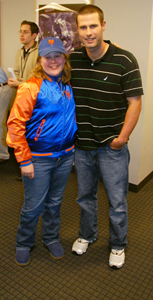
Hot in Baltimore, Hot on Houston Street, Hot at Home and hopefully,
Hot at Yankee Stadium!

Hot in Baltimore, Hot on Houston Street, Hot at Home and hopefully,
Hot at Yankee Stadium!
“This is Birdland,” proclaimed the banners at Camden Yards, the billboards around the Inner Harbor, and graphics on the Orioles’ website.
The jazz lover in me loved the reference to the famous Manhattan jazz club, first located at Broadway and 52nd Street when it opened in 1949. The club’s name is a reference to sax player Charlie Parker, or “Bird”, a regular performer at the club.
Prior to going to Camden Yards on Saturday, I knew that the 2010 Orioles–as well as Orioles teams of recent years–are a terrible team. Seeing them in action is truly sobering and serves as a sad testamant to its woeful ownership. While, as a Mets fan, I was most happy to take a sweep home courtesy of the Orioles, thank you very much, I couldn’t help but feel a little sorry for this pathetic team.
My husband found it very sad comparing the present-day team with glorious Orioles teams of yesteryear.
Not possessing his knowledge of the franchise’s history, I found it sad equating this group of underperforming players with the fine instrumentalists and singers that have enthralled fans of good music at the original Birdland as well as its present location on West 44th Street.
The list of jazz All Stars who appeared at the club in its early years reads like a veritable Who’s Who of Jazz:
Charlie Parker, Dizzy Gillespie, Thelonious Monk, Miles Davis, John Coltrane, Bud Powell, Stan Getz, Lester Young, Erroll Garner, and many others.
The current location has presented these fine jazz artists, among countless others:
Oscar Peterson, Pat Metheny, Diana Krall, Roy Haynes, Michel Legrand, Dave Brubeck, Pat Martino, Tony Williams, Hank Jones, Michel Petrucciani, Maynard Ferguson, Freddie Hubbard, Marian McPartland, John Pizzarelli, Kurt Elling, Joe Lovano, McCoy Tyner, Michael Brecker, Clark Terry, Ron Carter, Jon Hendricks, George Shearing, James Moody, Yellowjackets, John Scofield, Phoebe Snow, Dave Holland, and Tito Puente, as well as the big bands of Chico O’Farrill, Duke Ellington, Toshiko Akiyoshi, and Maria Schneider.
Many live recordings have been made at the club. John Coltrane: Live from Birdland is probably the most famous, although many others artists–Count Basie and Stan Kenton and their respective Orchestras, Charlie Parker himself, to name a few–have released recordings from performances at the club.
I know that a team’s PR department is given the unenviable task of promoting this team regardless of its record. I also realize that the reference to the illustrious jazz club is probably lost on all but a few of us. But for those of us with even a casual knowledge of the club’s history and of the countless legends of the jazz world, living and dead, who have performed to great acclaim there, the association is laughable.
Not only is the comparison unfair to these hapless underachievers, but it is also a false comparison.
Watching the Mets take hit after hit off of Kevin Millwood on Sunday and the apathetic way he returned to the mound following each one, I began to wonder if Camden Yards should’ve begun playing “Lullaby of Birdland” repeatedly between innings instead of “If You’re Happy and You Know It.”
Not only does one associate a lullaby with sleeping and lethargy, but how about these lyrics of George Shearing:
And there’s a weepy ol’ willow
He really knows how to cry
That’s how I cry in my pillow
Speaking of the live recordings made at Birdland, maybe the Orioles’ present incarnation is more deserving of a blues selection to be played between innings. Might I suggest the plodding, down-on-your-luck “Blues Backstage”, recorded live at Birdland by Count Basie and his Orchestra in 1961?
If the Orioles are ever able to turn things around and have a winning season, they could then revisit this album. I think a hard-playing, run-scoring, defensively crisp Orioles team could find no more representative up-beat, hard-driven music than “Whirly-Bird” on this very same album.
Something tells me, though, that the boys of Baltimore have a few more sets to play before they make this chart part of their regular rep.
Photo of Birdland by William Claxton
I’m exhausted.
And I was not the one performing athletic feats all afternoon and evening.
Sitting through yesterday’s doubleheader at Citi Field–including witnessing a tripleplay and Jon Niese’s one-hitter–made me wonder if ballplayers have specific regimens or diets for a long day such as that.
While not nearly so athletic a feat, I am often asked to perform doubleheaders myself.
The Metropolitan Opera performs seven operas a week during its regular season, including a matinee and an evening performance on Saturdays. Depending upon which operas are scheduled, I might be called upon to “play two” or not.
The advantage to doing so is that it gets two of the four shows per week dictated by my contract out of the way in one (long) day. For that reason, many orchestra musicians, if given the choice, prefer to be scheduled for “double Saturdays”.
Unlike ballgames whose endtime is never known, it is relatively easy to determine the approximate running time of an opera, barring any lengthy technical problems onstage or a cancellation by a singer and the necessary time required to get a cover warmed up and into costume.
However, even though the total performance time of the sum of the two operas on a double Saturday is predetermined, the actual time commitment can vary widely depending upon the two operas scheduled and each of their running times.
Yesterday’s doubleheader prompted me to think of some of the more memorable doubleheaders I’ve played.
I’m sure certain games go by much faster than others for the players, depending upon how fast the pitcher works, how many men get on base, how much the weather is an annoyance or distraction, whether it’s a home or away game, or other factors I have not even thought of.
I know that, for me, some operas SEEM longer to me than others that are actually longer, simply because I enjoy playing some operas more than others.
Clocking in at just over three hours, Puccini’s Madama Butterfly–the ultimate tear-jerker and rarely, in my experience cast well–always seems interminable to me.
Contrast that with the final opera in Wagner’s epic Ring Cycle: Götterdämmerung. The first act alone is two hours. Add two more acts and two intermissions, and you’re looking at a performance that takes just under six hours. And yet, any time I’ve played that opera, the time has seemed to FLY by.
Go figure.
*An additional challenge in this opera is that the last act is the longest act at 2 hours and ten minutes. In fact, the last act by itself is longer than all of La Bohème.
I grew up in northeastern Oklahoma, far away from any Major League Baseball. My mother was a fan however, and the Braves, via TBS, were often on the television in our home.
I also have memories of my mother standing at the kitchen sink, washing the dinner dishes, with a small AM radio placed strategically near the kitchen window. Barely audible over the hum of poor reception and static caused by far-off summer lightning storms, one could strain to piece together portions of innings of Royals games, courtesy of some station in rural Salina, Kansas, that faded in and out when it could even be picked up at all.
Whenever our family took vacations to major cities, a baseball game was often squeezed in around the obligatory historical sights, art museums, and concert halls.
I also enjoyed playing softball as a kid.
So, although it did not play a major role in my early life, baseball was always around.
Then in 1995, I married a Mets fan.
Credit for anything I have learned about baseball’s history, its players and heroes, its strategies and rules–written and unwritten, not to mention the passion for the game now instilled in me, must be given to my husband.
His knowledge of all things baseball is encyclopedic. His astounding memory enables him to conjure up stats, dates, and historical information in a manner that is uncanny and maybe even a little scary.
Therefore, it came as a total shock when I was able to illuminate him on something involving baseball.
***
My early Mets fandom coincided with some of Bob Murphy‘s last years as an announcer, but as a a long-time listener to Murphy, my husband, Garry, often regaled me with stories about the famed announcer.
A few years ago, a Mets game was postponed because of rain, just as it was tonight. Looking forward then as he is tonight to an entire day of baseball the next day, Garry waxed nostalgic for the days when Bob Murphy would announce with similar enthusiasm that a postponed game would be made up the following day as part of a “Cole Porter affair”, Murphy’s term for a day-night doubleheader.
Garry then confessed that he had no idea why Murphy used that expression.
Although my dear husband has just as encyclopedic a knowledge of classical music and opera as he does of baseball, he does not have such familiarity with music of more popular genres. Therefore, he did not recognize “day and night” as lyrics from “Night and Day” by Cole Porter, contributor to The Great American Songbook.
He now knows and never fails to give me credit for the insight.
For your listening enjoyment, the YouTube video features Ella Fitzgerald’s rendition of the song. Classic versions exist by Billie Holiday and Frank Sinatra, among others. It has also been covered by more contemporary artists, including The Temptations, Chicago, U2, and Rod Stewart.
It’s been TEN YEARS since the Mets swept the Marlins at home.
Maybe the long interim and the anticipation is what makes this Fish Dish SO delectable!
It’s quite evident that, with their major-league best 22-9 record at home, these boys prefer la cuisine de la maison, i.e., “HOME COOKIN’!”
Bon Appé***!
Well, no, of course not, Ollie. You’re absolutely correct: it DOES state in your contract that you must agree to the suggestion of going down to the minors.
But, see here, Ollie: by your staying up here with the club, you’re not putting yourself in a position to improve.
Yes, yes. We know. Nobody can MAKE you. But, Ollie, didn’t nice Mr. Boras tell you that he thought it was a good idea? And you know that he always has your very best interests in mind, don’t you? Wasn’t he the one that got you this cush..[ahem] big contract in the first place?
Son, we’ll say it again: there is absolutely no shame in accepting this assignment. Other pitchers have been asked to do the same thing and, with time and effort, they’ve been able to solve their problems and make a successful return to the team. We want to help you with this, Ollie. Really, we do.
Well, but you see, Ollie, you may THINK that there is no problem, but opposing hitters have a way of telling us that in fact you really DO have a problem.
No, wait. Please! Not a problem that can’t be RECTIFIED. Not a problem without a solution!
There, there. Settle down.
Now, Ollie. Let’s be reasonable, shall we? We are committed to you and your successful return to the bigs 100%. [You’d better believe we are, for what we’re paying you.]
We are talking about a short period of time. A brief part of your otherwise illustrious career. And, hey, it’s not like you’re going to be slumming it while you’re there: we’ve arranged first class travel and major league per diem for you while you’re there–just like you enjoy now.
You’d be surprised how far that goes in upstate New York or in the Miami area!
Okay, Ollie. We get it.
You don’t want to go to Buffalo. You don’t want to go to Port St. Lucie.
But, you know what, Son? We don’t always get what we WANT in life!
What’s that?
Your WHAT?!
Just now?
You’re kidding, right?
Your KNEE?
But…
I’m sorry, but I fail to see the humor in this, Perez.
Oh for God’s sake. Will someone please get Ray Ramirez in here?!
Which knee is it, Ollie?
No, Ollie, that was most certainly not meant to be a trick question.
If you’ve watched any baseball coverage today, you have probably seen video footage of both Tampa Bay Rays’ Carl Crawford and his manager Joe Maddon in heated arguments with homeplate umpire Bob Davidson prior to and following their ejections in the sixth inning of last night’s game against the Boston Red Sox in Tampa.
In case you might have missed this dramatic display, watch it here.
I’ve seen countless ejections as a spectator, but I was captivated by this video footage because of how seemingly out-of-control Davidson himself seemed to be. I wondered: Aren’t umpires charged with setting the tone of games and maintaining a sense of decorum?
I was also fascinated to see two individuals (Crawford-Davidson and then Maddon-Davidson) so completely invade each another’s personal space–as close as they could be without touching– simultaneously yelling at the top of their lungs.
The display intrigued me enough that I posted the video on my Facebook Wall, along with commentary similar to that written above.
I received numerous comments, but one of them prompted this post.
A member of the Metropolitan Opera Chorus, Craig Montgomery, commented on my post,
“Actually, that’s sort of what singing an opera duet looks like :)”
And he is absolutely correct.
Any singer worth his/her conservatory training knows that, in order to project the voice over the orchestra, he/she must sing out directly toward the audience. However, in the interests of staging and realistic portrayals of his/her character (not to mention variety), singers often find themselves singing in acoustically or musically compromising situations.
I have witnessed singers deal with these challenging situations, among others:
The following clip features soprano Waltraud Meier and tenor José Cura in a duet from Mascagni’s Cavalleria Rusticana. The video appears to have been recorded in 1996 in Ravenna, Italy, with Maestro Riccardo Muti conducting.
About 2:30 into the clip, Meier and Cura–in the roles of Santuzza and Turiddu, respectively–the intensity of the couples’ exchange prompts them to embrace and get very close to one another, singing passionately into each other’s faces. The “other woman” enters shortly thereafter and after her departure, at about seven minutes or so into the video, Turiddu grows tired of Santuzza’s jealous rage, becomes enraged himself and, again, they sing at full voice directly facing each other, so close that their lips almost touch.
Take a look:
Soprano Renée Fleming, recently described operatic expression as “controlled screaming”.
“Basically we holler – in an extremely cultivated way, of course!”
I guess it can then be said that, in the passion of the moment–both in opera as well as in sports–the line between refined sound/decorum and yelling–“cultivated” or otherwise–can be a thin one in the name of art/the game.

The Phillies return tonight to Citi Field. Since their last visit, accusations have come out that the Phillies’ bullpen coach, Mick Billmeyer has been stealing signs, using binoculars.
Major League Baseball issued an executive order in 2001 barring the use of “electronic equipment”, citing that it could not be used “for communications or for the purpose of stealing signs or conveying information designed to give a club an advantage.”
Obviously, bincoluars do not constitute “electonic equipment”, but their alleged use in this situation seems suspect, at best.
Yes, yes, I know: stealing signs has been around for as long as there’s been baseball. But, somehow, stealing signs with the aid of binoculars seems egregious to others besides me. The Rockies filed a formal complaint against the Phillies over the matter and the team was reprimanded. Rockies manager Jim Tracy stated,
“A pair of binoculars staring down the gun barrel of the hitting area, I don’t think a club in baseball that’s competing against that team would take too kindly to that,” Rockies. …You start reflecting back on some of the things that have taken place in previous games and it makes you sit here and wonder a little bit.”
And here’s what Cy Young winner Steve Stone was quoted as saying when Sammy Sosa was taken to task for stealing signs by the Cardinals in 2002:
“To be honest with you, sign-stealing used to be much more of an art than it is now. But as long as you are not stealing signs from the scoreboard, using a camera or something, then you are stealing legitimately.”


Because of the accusations, the rather absurd retort by Charlie Manuel that he found the Mets’ astounding home record (at that time, anyway) suspicious, along with the usual animosity created by uncivilized Phillies fans in our ballpark, I’m willing to bet the fans, if not the players themselves, will show up tonight on the lookout for any signs of foul play and ready to extract vengeance in the form of a big win.
The New York Mets season is not over…yet.
I did, however, just conclude my eighteenth season at the Metropolitan Opera.
Just as general managers of baseball franchises purchase the contracts of players and make trades in the off season to fill available positions, the end of our season often sees openings created by retirement.
As I write this, many of my colleagues are involved in the culmination of a four-day endeavor to select a new First Horn: a very key position in any orchestra.
Barring any unforseen circumstances, by today’s end, a new Principal Horn of the MET Orchestra will be named.
*****
Not too many years back, vacancies in orchestras were filled through arrangements between a conductor and a player that he knew from somewhere else or whom that instrument’s section leader knew–usually a student. It was arranged that the musician would play for the conductor, sometimes as briefly and informally as in the conductor’s dressing room prior to a rehearsal or concert. He was then handed the job.
I use the pronoun “he” because female conductors as well as female orchestral players were unheard of in the early twentieth century.
Because of the strength of the musicians’ union and because of the general increase in the numbers of capable players worthy of consideration, most positions are now filled through an audition process.
Audition notices are published in the monthly newsletter of the American Federation of Musicians. Interested candidates may submit a resumé and request to be sent the excerpts–the specific passages from longer works which the committee will hear during the audition.
While such auditions are supposed to be conducted fairly, prejudices often play a part of the decision-making process. It is understandably difficult to remain objective when serving on an audition committee when one is hearing a player who (1) has been subbing in the position and has been deemed worthy–and deserving–through that informal trial basis, (2) has been his or her student, (3) or is a personal friend or acquaintance. Further discrimination can occur, consciously or subconsciously, on assumptions made by the age of the candidate, the candidate’s known experience (or lack thereof), the make of instrument on which the candidate plays, or even the gender of the candidate.
The MET does something in its auditions that, to my knowledge, no other orchestra has utilized: every single round of the audition is conducted with the candidates placed behind a screen. The committee is then left to evaluate the candidate strictly on the merits of the music the candidate is making. When, for example, “Number Two” is declared the winner and comes around to meet the committee, his/her identity is not known to the members of the committee.
I think it is hardly a coincidence that our orchestra boasts a large number of women in its ranks as well as extremely accomplished very young players–some of whom won their jobs before they were even out of music school.
*****
Because I’ve always been intrigued that there are so many parallels between playing for a baseball team and playing in an orchestra, I am also very interested when I find or think of distinct differences between being a player on “my” team and a player on a MLB team…beside the issue of payscale, I mean.
I have often wondered what the music world would be like if music directors or general managers of music ensembles orchestrated trades to fill vacancies. While I have had colleagues who left the MET Orchestra to play in the New York Philharmonic, the Chicago Symphony, the Boston Symphony, and the San Francisco Symphony, the MET did not receive a player in return for these musicians.
The “Player to be Named Later” was named following an open audition on OUR end.
Spring Training can be a somewhat informal “audition” of sorts, I suppose. Some players will make the team and others will not, of course. Auditioning for a specific position, while not as common, does happen. After all, it wasn’t until after Opening Day that Jerry Manuel awarded the Center Field position to Angel Pagan over Gary Matthews, Jr.
But to think of (1) ball players auditioning in a way that did not reveal their identity and/or (2) having them perform certain plays, i.e., throw certain pitches, catch balls going to the left/right, basket catch, shoestring catch, etc.–as a “tryout”, in the manner of prepared excerpts from the orchestral literature, is downright hilarious.
Imagine a batting cage sheathed in dark cloth so as not to disclose the identity of the batter.
Obviously, in order to properly evaulate a prospective player, one has to watch him react, see how tall he is, observe his batting stance, and countless other visual clues to his abilities.
While I believe the MET’s anonymous audition process has worked well as a hiring procedure, I can still fantasize about the scenario of musicians being traded and finding themselves making music in another city with different colleagues with little or no notice (if he or she chose to waive any No-Trade Clause.)
“Hello, Susan? It’s the Philadelphia Orchestra calling.”
UPDATE: Colleagues from the brass section responded last night to my inquiries regarding the results of the audition and informed me that the committee had selected Erik Ralske, acting Associate Principal Horn (for the past 5 years) and, prior to that, Third Horn for the New York Yankees, er, New York Philharmonic.
I also neglected to mention in the first publication of this post that the Principal Horn vacancy was created by the retirement of distinguished Principal Horn, Julie Landsman. Julie is a dynamic, inspiring player that has led that section with distinction since 1985. She is also on the faculty of the Juilliard School of Music and has former students in many major orchestras, including the MET Orchestra and the Philadelphia Orchestra.